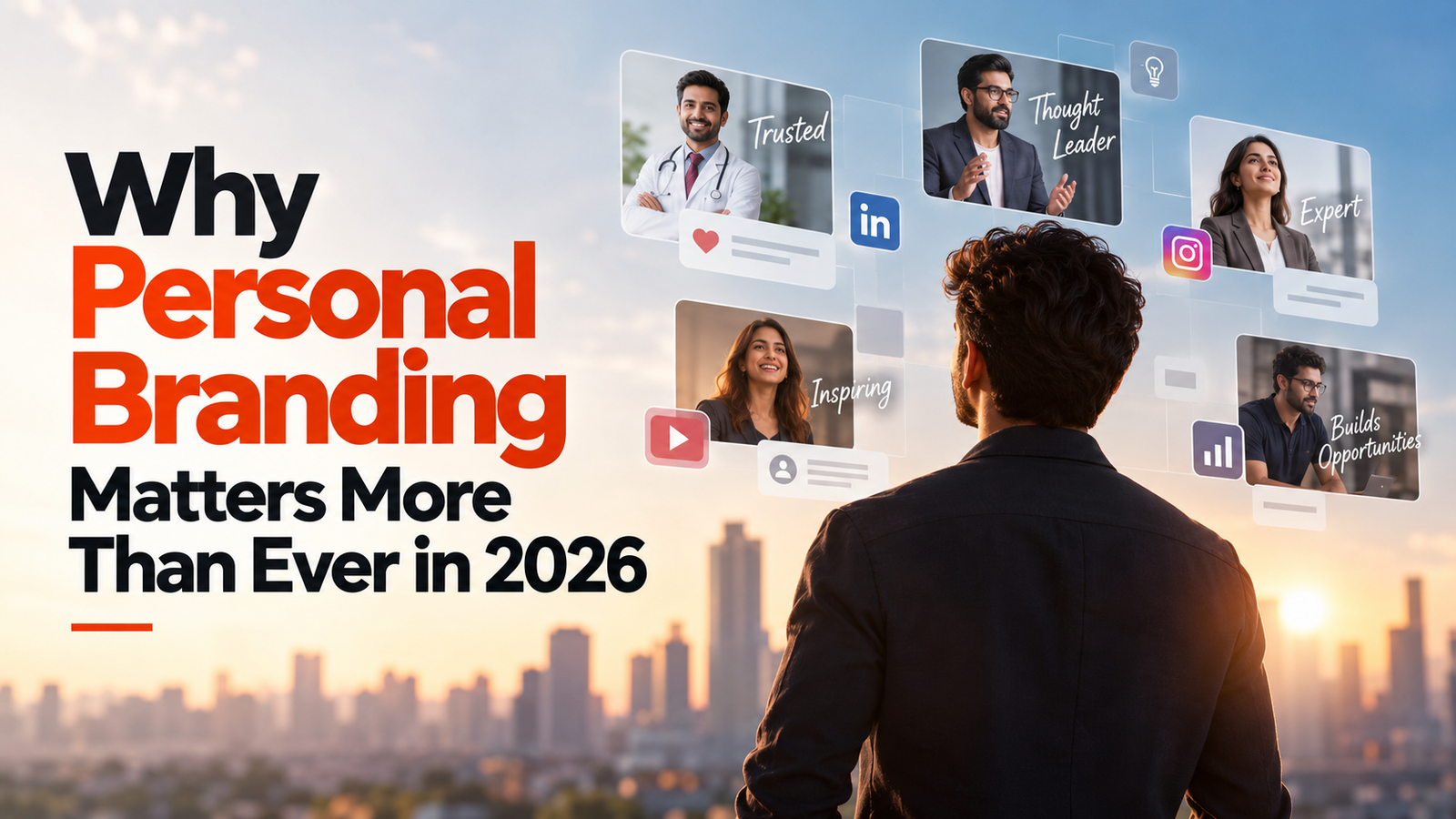
Why Personal Branding Matters More Than Ever in 2026
A few years ago, personal branding sounded like something only celebrities, influencers, or LinkedIn experts needed to worry about.
Today, that has changed.
Whether you're a doctor, founder, CEO, consultant, entrepreneur, creative professional, or simply someone building a career, people are increasingly looking at you, not just the company you represent.
Before they book a consultation, hire you, invest in your business, attend your workshop, or even reply to your message, they may look you up online.
And what they find can influence what they think about you.
That is why personal branding in 2026 is no longer just about being visible. It's about being remembered, trusted, and understood.
What exactly is personal branding?
Personal branding is not simply posting photos on Instagram or sharing motivational quotes on LinkedIn.
It is the way people understand who you are, what you know, what you stand for, and why they should listen to you.
Think about the people you know in your industry.
You probably associate some people with a particular area of expertise immediately.
"That's the doctor who explains things really simply."
"That's the founder who always talks about building great teams."
"That's the consultant who knows everything about performance marketing."
That association is personal branding.
It's the space you occupy in someone's mind.
Why is personal branding becoming so important in 2026?
1. People want to know the person behind the business
We live in a world where brands can look polished almost instantly.
AI can generate content. Templates can create beautiful designs. Businesses can build websites in days.
But when almost everyone can look professional, being human becomes a differentiator.
A 2026 Clutch survey found that 93% of consumers said it matters that brand communications feel like they came from a real person.
People want to see the person behind the logo.
They want to understand your story, your experience, your opinions, and your way of thinking.
That is where personal branding becomes powerful.
2. Your digital presence often becomes your first impression
Imagine someone hears your name for the first time.
What happens next?
They Google you.
They check LinkedIn.
They look at Instagram.
They watch a few videos.
They may visit your website.
In a matter of minutes, they start forming an impression.
And here's the important part:
You don't completely control what people find about you — but you can influence what you consistently put out there.
A clear personal brand makes that first impression much easier.
3. Expertise needs a voice
Being good at what you do is important.
But being good at something and being known for it are two different things.
You might have 15 years of experience in your field. But if nobody knows what you know, that expertise stays invisible.
This is why content matters.
Share what you've learned.
Explain complicated ideas simply.
Talk about mistakes you've made.
Share your perspective on industry changes.
Answer the questions your customers repeatedly ask.
Over time, these small pieces of content can build something much bigger: authority.
Research around thought leadership has also found that decision-makers can view high-quality expert content as a stronger indicator of capability than traditional marketing materials.
4. AI is making authentic personal brands more valuable
This might sound slightly ironic.
AI has made it easier than ever to create content.
But that also means there is more content than ever before.
The challenge isn't simply producing another post.
The challenge is producing something that feels like you.
Your experiences cannot be copied.
Your way of explaining something cannot be completely replicated.
Your stories, failures, lessons, opinions, and personality are yours.
As Gartner noted in 2026, with content becoming abundant and inexpensive to produce, trusted human perspectives and expertise are becoming increasingly important signals of credibility.
So yes, use AI.
Use it to brainstorm.
Use it to research.
Use it to organise your thoughts.
But don't let it replace your voice.
The technology can help you create. Your personality makes people care.
5. Personal branding can create opportunities you weren't actively looking for
One of the biggest advantages of personal branding is that opportunities can start coming to you.
A founder might discover you through a LinkedIn post.
A potential client might find one of your videos.
A podcast host might come across your expertise.
A journalist might discover your perspective.
A company might approach you for a collaboration.
You may not have searched for these opportunities.
They found you because your presence was already there.
That's the difference between simply networking and building a reputation that works even when you're not in the room.
6. Your personal brand can strengthen your business brand
For founders and business owners, this is especially important.
People may know your company name.
But they may connect more strongly with the person leading it.
A founder talking about the company's journey, challenges, values, customers, and vision can make the business feel much more relatable.
This doesn't mean the company brand becomes less important.
It means the two can work together.
Your business builds recognition.
Your personal brand builds connection.
And together, they can create a much stronger presence.
So, what should you actually post?
You don't need to become an influencer.
You don't need to post every day.
And you definitely don't need to turn your life into content.
Start with things you already know.
Try sharing:
Lessons from your industry
Frequently asked customer questions
Your professional experiences
Behind-the-scenes moments
Opinions on relevant industry trends
Mistakes and what you learned from them
Case studies and success stories
Stories behind your business
Short educational videos
Your perspective on common problems
The key is consistency.
Not perfection.
A personal brand isn't built from one viral post.
It's built from repeated signals over time.
Personal branding isn't about pretending to be someone else
This is probably the most important part.
Don't build a personal brand around what you think people want to see.
Build it around what is genuinely true about you.
If you're serious, don't suddenly become motivational.
If you're funny, don't force yourself to sound corporate.
If you love teaching, teach.
If you love storytelling, tell stories.
If you have strong opinions, explain them thoughtfully.
The strongest personal brands don't feel manufactured.
They feel familiar.
People see your content and think:
"Yep. That's exactly how they talk."
And that familiarity creates trust.
The 2026 personal branding mindset
Personal branding used to be about asking:
"How do I get more followers?"
In 2026, a better question is:
"What do I want people to remember me for?"
That's a much more useful starting point.
Because 10,000 random followers may not mean much.
But being the person someone thinks of when they need a particular solution?
That's valuable.
Your goal isn't necessarily to be everywhere.
It's to be clear, credible, consistent, and recognisable.
Start before you think you're ready
You don't need a perfect studio.
You don't need expensive equipment.
You don't need thousands of followers.
You don't even need to be comfortable on camera on day one.
Start with one useful idea.
Share it.
Then share another.
Keep showing up.
Over time, people begin to recognise your face, your voice, your ideas, and your expertise.
And eventually, your name starts carrying meaning.
That's what personal branding really is.
Not becoming famous.
Becoming known for something that matters.
Building your personal brand?
At PickleMonk, we believe good personal branding starts with clarity — understanding what you want to be known for, who you want to reach, and how you want to communicate.
From strategy and creative content to video production and digital communication, we help turn expertise into a brand people can actually connect with.
Your name is already a brand. The question is: what does it stand for?